Friday Night Funkin' vs Indie Cross
About This Game
Friday Night Funkin' vs Indie Cross
1. Introduction
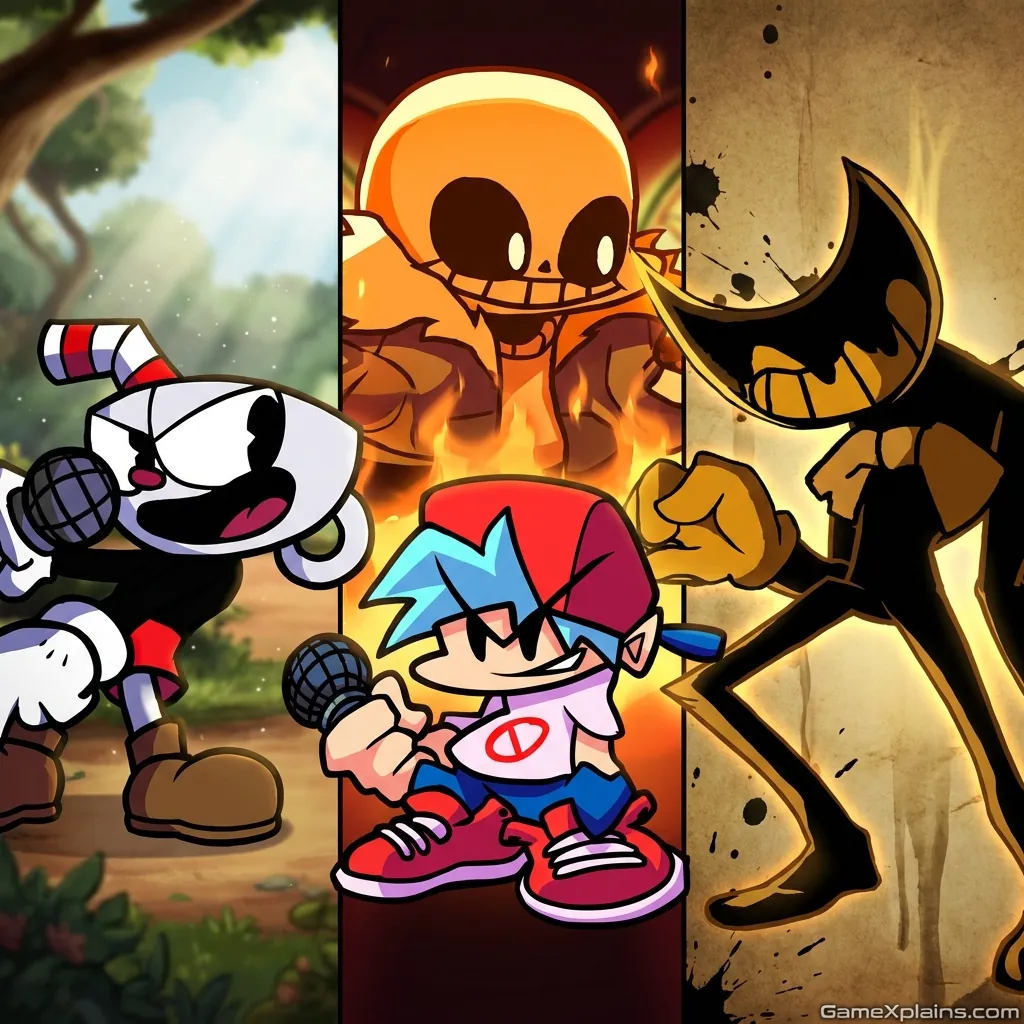
Friday Night Funkin' vs Indie Cross is an FNF mod mashup that asks one thing from you, hit notes on time under pressure. It looks simple until patterns speed up, fake-outs appear, and long strings demand consistency instead of hero taps.
Play Now: Jump into the online/browser game and start on an easier song to lock in timing before pushing difficulty.
Because many versions run as an HTML5 game in a browser (sometimes with WebGL for rendering), performance and input latency can vary slightly by device and browser.
2. Key Features
Multi-song battles that ramp difficulty through denser patterns and faster transitions.
Clear feedback loop: accuracy, misses, and combos show what to fix immediately.
Character themed weeks that remix familiar FNF structure with crossover flavor.
Higher difficulty charts that reward steady rhythm and controlled finger movement.
Practice friendly design: replay songs quickly to learn patterns and reduce misses.
Works as an online/browser game in many releases, often as an HTML5 game.
3. What is Friday Night Funkin' vs Indie Cross?
Friday Night Funkin' vs Indie Cross is an FNF Mods entry built around the classic FNF loop: read incoming arrows, match inputs on the beat, and survive the song without draining your health bar. The tactical dynamic is timing under stress, when patterns get dense, you must choose stability over speed.
What makes it stand out is the crossover framing and the way charts often lean into surprise rhythms, sudden bursts, and stamina testing strings. In most versions, your goal is consistent accuracy across multiple tracks in a week, not just a single flashy clear.
4. How to Play
Your objective is to finish each song with enough health remaining to complete the battle. You lose when you miss too many notes or repeatedly hit far off-timing inputs until your health drains to zero. You typically improve by replaying the same sections, learning pattern shapes, and reducing late or early hits.
Controls (table)
Action | Keyboard | Notes |
|---|---|---|
Hit notes | Arrow keys or WASD | Use whichever mapping feels more consistent. |
Pause | Enter or Esc | Varies by version, check the in-game menu. |
Confirm/Menu | Enter | Some versions also accept Space. |
Back/Menu | Esc | Useful between songs or when restarting. |
Progression usually follows a week format. Clear one song to unlock the next in the set, then finish the full week to move on. If you notice a section that repeatedly breaks your run, restart and aim to reach it with high health so you have room to learn.
Experience cue: If your inputs feel correct but you still miss, switch browsers or close background tabs to reduce input lag.
5. Core Gameplay Mechanics
1) Main system
When arrows reach the target zone, the game checks your input timing against a window around the beat. Hit inside the window and you keep combo and health. Hit late, early, or not at all and you lose health. In most versions, better accuracy stabilizes your health so you can survive harder sections.
2) Tactical dynamics
When you see dense stair patterns or quick alternations, do smaller, more controlled presses instead of mashing. The goal is rhythm consistency, not raw speed. When a section introduces sudden bursts, focus on the first two notes to anchor the tempo, then ride the pattern shape through to the end.
3) Progression and scaling
As you move through songs or higher difficulties, patterns typically get more complex: longer streams, quicker transitions, and more frequent direction changes. Difficulty often scales by reducing your margin for error and increasing stamina demands. Your best upgrade is pattern recognition, once you recognize a shape, you stop reacting note-by-note.
4) Key elements
Health acts as your fail state buffer. Combos reward consistency and often correlate with better survivability. Hazards include fast bursts, long strings, and rhythm changes that bait early inputs. If your health is low, prioritize safe hits over perfect hits to prevent a cascade of misses.
Decision Flow (Quick Win Rule)
Misses spiking? Yes -> Slow down fingers -> Hit center timing -> Rebuild combo No -> Health low? Yes -> Prioritize safe hits -> Avoid risky speed-ups No -> New pattern? Yes -> Watch 1 bar -> Copy shape -> Commit No -> Push difficulty -> Repeat songs -> Improve consistency
6. Strategies
Anchor the Downbeat: Lock your attention to the first note of each phrase and treat it like a reset point. This keeps your hands synced when patterns change mid-song. Warning: If you stare at one arrow too long, you may miss side notes; keep soft focus.
Two-Note Stabilizer: When bursts appear, intentionally hit the first two notes cleanly, then follow the pattern’s direction changes. This reduces panic misses and keeps health steady. Warning: Overcorrecting after a mistake often causes a second miss, recover on the next beat.
Micro-Taps Over Mash: Use short, light presses for fast alternations. It prevents input overlap and helps you stay inside the timing window. Warning: If your keyboard repeats or sticks, switch keys (WASD vs arrows) to find cleaner hardware response.
Phrase Chunking: Mentally group streams into small chunks of 4 to 8 notes, then breathe between chunks. Chunking turns long strings into predictable units. Warning: If you lose the beat, stop chasing perfection, aim for consistent mid-accuracy until the phrase ends.
Health Buffer Routing: Enter hard sections with a health cushion by playing safer earlier parts. If a section always drains you, treat the earlier bars as “prep time” and avoid unnecessary risks. Warning: Do not restart too early; reaching the problem spot teaches more.
Latency Check Routine: If hits feel late, adjust your approach: press slightly earlier and test the same passage three times. If it changes run-to-run, the issue is likely device load. Warning: Wireless keyboards and Bluetooth can add delay, wired often feels tighter.
Experience cue: If you start missing after a long stream, your fingers are probably tensing. Relax your shoulders and reduce press force.
7. Similar Games
8. FAQ
What is FNF Indie Cross about?
It is a crossover-style FNF mod where you play rhythm battles themed around indie characters and weeks. The core is still timing notes to the beat while managing health through accuracy. Exact content can vary by version, but it is typically structured as multi-song weeks with difficulty options.
Is FNF GF autistic?
There is no universally confirmed canon statement across all versions that labels Girlfriend as autistic. FNF has many mods and fan interpretations, and those can add their own characterization. If you see that claim, treat it as version-specific or fan-made unless the source is clearly official.
Is FNF week 7 inappropriate?
Week 7 often includes stronger language and more intense presentation than earlier weeks. Whether it is inappropriate depends on the player’s age and tolerance for mild profanity and themes. Many online/browser game portals also offer content notes or tags, so check those if available.
Who made the FNF but bad mod?
FNF mods are made by different creators, and “FNF but bad” can refer to more than one parody or comedic mod release. The safest approach is to check the specific mod’s credits screen, mod page description, or its distribution page, since authorship can vary by upload.
How hard is Friday Night Funkin' vs Indie Cross for beginners?
It is usually harder than base FNF on higher difficulties because patterns can spike suddenly and demand stamina. Beginners should start on an easier chart, replay short songs, and focus on reducing misses first. Once you can finish songs reliably, chase higher accuracy.
Can I play FNF Indie Cross online?
Many builds circulate that run as an online/browser game, and others require local files depending on the host. If you are playing in a browser, prioritize stable performance and low input lag. If inputs feel inconsistent, try another browser and close background apps.
9. Technical
Friday Night Funkin' vs Indie Cross is commonly shared as an HTML5 game that runs in a web browser (and may use WebGL for visuals). Supported browsers are typically Chrome, Edge, Firefox, and Safari. Most mid-range devices should run it smoothly, but rhythm games are sensitive to input latency.
Controls are usually keyboard-based on desktop, with some versions supporting touch controls on mobile. If the build you are using is browser-playable, it is typically no download. If a host provides an executable build, that is a separate download-based version.
Experience cue: If audio and notes drift out of sync, refresh the page and avoid running other audio apps in the background.
10. Final Verdict
Friday Night Funkin' vs Indie Cross is a strong pick if you want an FNF Mods challenge that emphasizes timing discipline, pattern recognition, and stamina through full weeks. Its biggest strengths are the week structure and the way charts can force you to learn clean inputs. The main limitation is version variance, performance and exact content can differ by host.
Comments (0)
No comments yet. Be the first to share your thoughts!