FireBoy and WaterGirl: The Forest Temple
About This Game
FireBoy and WaterGirl: The Forest Temple
1. Introduction
FireBoy and WaterGirl: The Forest Temple is a classic two-character co-op puzzle run where timing, switches, and element hazards decide everything. You are not trying to outscore anyone. You are trying to route two heroes through the same maze without letting either one fail.
Play now: Launch the online/browser game and start with Level 1 to sync your teamwork.
This is typically an HTML5 game that runs in a modern browser on desktop or mobile, and it plays best with a keyboard for two players.
2. Key Features
Two-character co-op routing where each player solves half the path, then recombines.
Element hazards create clear fail states, water vs lava is always a hard stop.
Switches, levers, and push blocks reward tight timing windows and clean movement.
Color-coded doors and gems give simple objectives with surprisingly tricky execution.
Level pacing ramps by adding mirrored tasks, split timing, and multi-step gate chains.
Works well as an online/browser game session because rounds are short and reset fast.
3. What is FireBoy and WaterGirl: The Forest Temple?
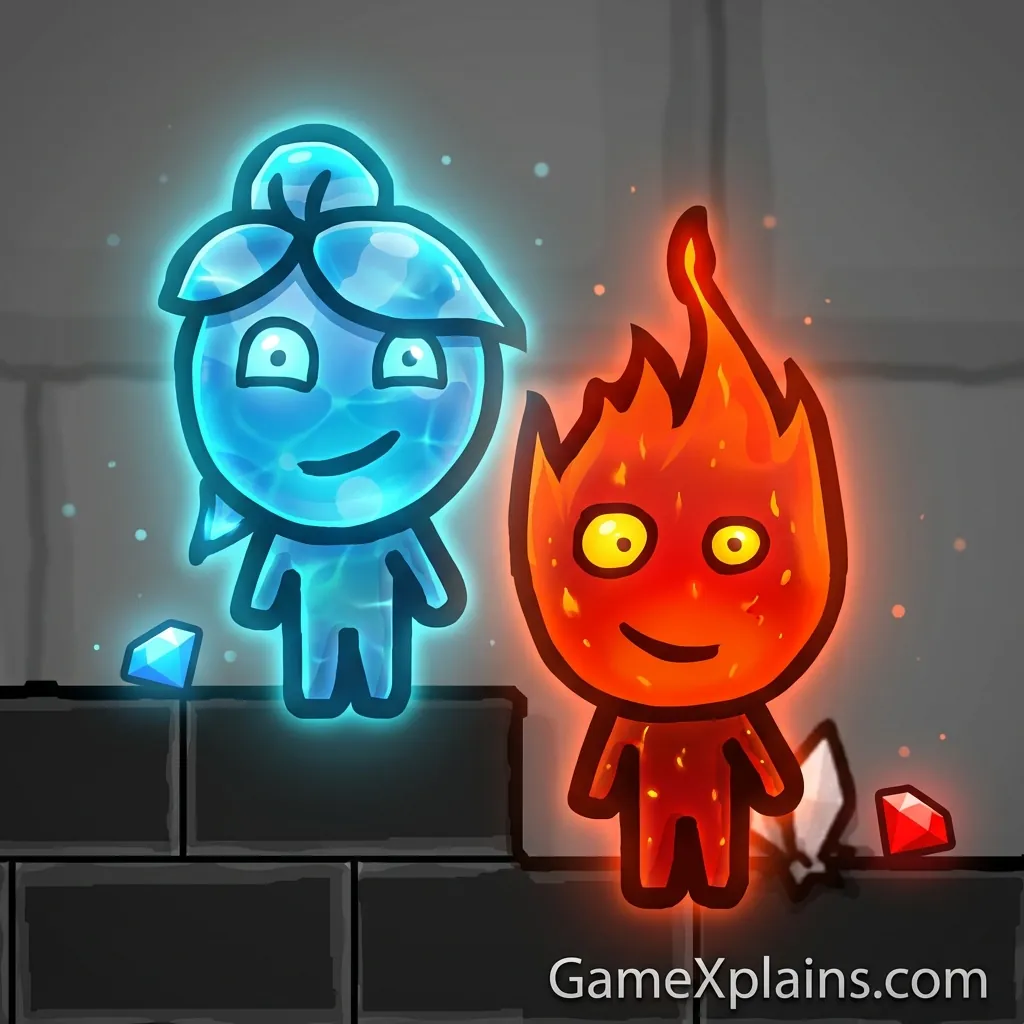
FireBoy and WaterGirl: The Forest Temple is a 2 Players puzzle platformer where you control two heroes with opposite elemental rules. The core loop is simple: move FireBoy and WaterGirl through a temple, collect diamonds that match each character, and reach each character’s exit door.
The tactical dynamic is all about coordination. One player often has to hold a platform, trigger a switch, or move a block so the other can cross. What makes this entry feel different from later chapters is its “Forest Temple” emphasis on levers, basic light beams, and classic gate logic rather than more exotic gimmicks you see in Fireboy and Watergirl: Elements.
If you came from Fireboy and Watergirl 1, the Forest Temple is usually the baseline style players remember. If you are comparing across the series like Fireboy and Watergirl 2 or Fireboy and Watergirl 5, the skill here is still transferable: precise jumps, safe handoffs, and clean switch timing.
4. How to Play
Your goal is to finish each level with both characters alive and standing in their matching doors. You usually lose a level if either character touches the wrong hazard or gets trapped by a closing gate.
Rules, win and lose conditions
Win: both characters reach their correct exits, often after collecting optional diamonds.
Lose: either character dies by touching the wrong element (or falls into a hazard), or you soft-lock the puzzle (for example, a block stuck where it cannot be moved back).
Optional objective: collect diamonds for a cleaner run, but most levels can be completed without every gem.
Controls (table)
Character | Move | Jump | Interact notes |
|---|---|---|---|
FireBoy | Arrow keys | Up arrow | Use levers, push blocks, avoid water pools |
WaterGirl | WASD | W | Use levers, push blocks, avoid lava pools |
If you are asking “Is Watergirl wasd?”, the answer in most versions is yes: WaterGirl uses WASD while FireBoy uses arrow keys.
Practical cues you can test
If you keep slipping off narrow ledges, use short tap movement instead of holding a direction.
If a gate closes too early, one player should stop moving and hold the switch until the other fully clears.
If a push block feels “stuck,” step slightly away, then re-approach to realign the push angle.
5. Core Gameplay Mechanics
1) Main system
When you move FireBoy and WaterGirl through a room, the game checks two things constantly: each character’s collision with platforms, and each character’s collision with element hazards. When you hit a lever or step on a button, the level state changes, usually opening gates, moving platforms, or redirecting paths.
2) Tactical dynamics
When you see split routes, treat them like a relay. One player advances until they hit a dependency (a button, a timed gate, a blocked jump), then pauses to support the other. When you see colored diamonds, prioritize the safe one first, because greedy detours are how teams desync and die.
3) Progression and scaling
When levels get harder, they typically add layered dependencies: one switch opens a path that leads to a second switch that creates a temporary platform for the other character. The timing window tightens, and you must plan your order of operations so you do not trap a character behind a one-way gate.
4) Key elements and fail states
Key elements include levers, floor buttons, push blocks, moving platforms, and pools of lava or water. FireBoy usually cannot touch water, and WaterGirl usually cannot touch lava. Green or neutral pools may be unsafe for both in many versions, so treat them as a hard hazard unless you confirm otherwise.
Decision Flow (Quick Win Rule) Start level Do you see a timed gate? Yes -> Assign holder -> Runner crosses -> Call “clear” -> Swap roles No -> Any push blocks needed? Yes -> Move block first -> Park it safely -> Then collect diamonds No -> Route both to exits -> Confirm doors match -> Finish
6. Strategies
Clean Sync Starts
Count down before the first move, then take two steps and stop together. This sets a shared pace and prevents early desync that turns into missed switches later. Warning: if one player is on a moving platform, do not stop mid-ride, stop after landing.
Switch Ownership
Assign “ownership” of each switch: the holder calls when they are stepping on, and the runner calls when they are past the danger point. This reduces timing mistakes in Fireboy and watergirl the forest temple walkthrough style levels. Warning: do not leave a switch until the runner confirms they are safe.
Diamond Last Routing
Treat most diamonds as optional until the path is stable. First, open the exit routes and identify any one-way gates. Then backtrack for diamonds only when both characters can return safely. Warning: if backtracking forces a timed gate repeat, skip the diamond and finish.
Block Parking Rule
When you push a block, move it to a “parking spot” that never blocks a door, button, or narrow jump. A parked block becomes a tool, not clutter. Warning: avoid pushing blocks onto switches unless you are sure you can remove them later.
Safe Jump Calls
Use short, specific calls: “jump now,” “hold,” “wait,” and “go.” In two-player online/browser game sessions, clear calls are faster than explaining. Warning: if one player dies often on the same jump, swap who goes first so the other can watch the timing window.
Light and Mirror Checks
In levels that feature Fireboy and Watergirl light mechanics, verify the beam path before either player commits to a hazard crossing. Move reflectors first, then run the crossing. Warning: if a beam-controlled platform is moving, wait for the stable position, not the “almost there” moment.
7. Similar Games
If you want more co-op thinking games, explore Puzzle.
If you enjoy step-by-step switches and pattern solving, explore Logic.
8. FAQ
How to play Fireboy and Watergirl Forest Temple?
You play by controlling two characters at once, one with arrow keys and one with WASD, and guiding both to their matching exit doors. Each room uses levers, buttons, blocks, and platforms that require teamwork. If one character touches the wrong hazard, the level typically restarts.
Are Fireboy and Watergirl siblings or dating?
Most versions do not confirm a relationship in-game, so it is usually left ambiguous. The series presents them primarily as paired heroes who solve temples together. If you see fan explanations online, treat them as interpretations, not official story details.
Can Fireboy and Watergirl touch each other's element?
Typically, no. FireBoy usually cannot survive water pools, and WaterGirl usually cannot survive lava pools. In many versions, green pools can be dangerous to both, so assume they are unsafe unless the level clearly shows otherwise. Safe surfaces are usually neutral platforms and ramps.
Is Watergirl wasd?
Yes, in most standard keyboard versions WaterGirl uses WASD for movement and W to jump. FireBoy usually uses the arrow keys and Up to jump. Some mobile ports remap controls to touch buttons, but the core separation stays the same so two players can act independently.
Is Fireboy and Watergirl online multiplayer actually online?
It depends on the site and version. Many browser versions are local co-op on one keyboard, even if the page calls it “multiplayer.” If you are on separate devices, you typically need a platform that supports online co-op specifically. Otherwise, plan for couch co-op or shared keyboard play.
Where do Fireboy and Watergirl 1, 2, 5, and Elements fit?
They are usually separate entries with different temple themes and mechanics. Fireboy and Watergirl 1 is often the baseline style, Fireboy and Watergirl 2 emphasizes light puzzles, Fireboy and Watergirl 5 expands the series with new temple variations, and Fireboy and Watergirl: Elements mixes multiple mechanic types.
9. Technical
FireBoy and WaterGirl: The Forest Temple is commonly offered as an HTML5 game (and may use WebGL depending on the build). It should run in Chrome, Firefox, Edge, and Safari. Most mid-range laptops and phones handle it smoothly, but older devices may stutter on moving-platform heavy rooms.
Controls are keyboard-first for two players, and some versions provide touch controls on mobile. As an online/browser game, it usually requires no download, but that can vary if you are using an app-based port instead of a web page. If input feels delayed, close extra tabs and avoid battery saver modes.
10. Final Verdict
FireBoy and WaterGirl: The Forest Temple succeeds because the rules are clear and the teamwork demands are real. You always know what you did wrong when you fail, and you can fix it with better timing, better role calls, and safer routing. The limitation is that many levels punish sloppy movement, so new players may restart often.
If you want a free co-op puzzle run that works as a tight online/browser game session, this is an easy recommendation. Start simple, assign switch roles, and finish levels clean before you chase every diamond.
Comments (0)
No comments yet. Be the first to share your thoughts!