Golf Peaks: Puzzle
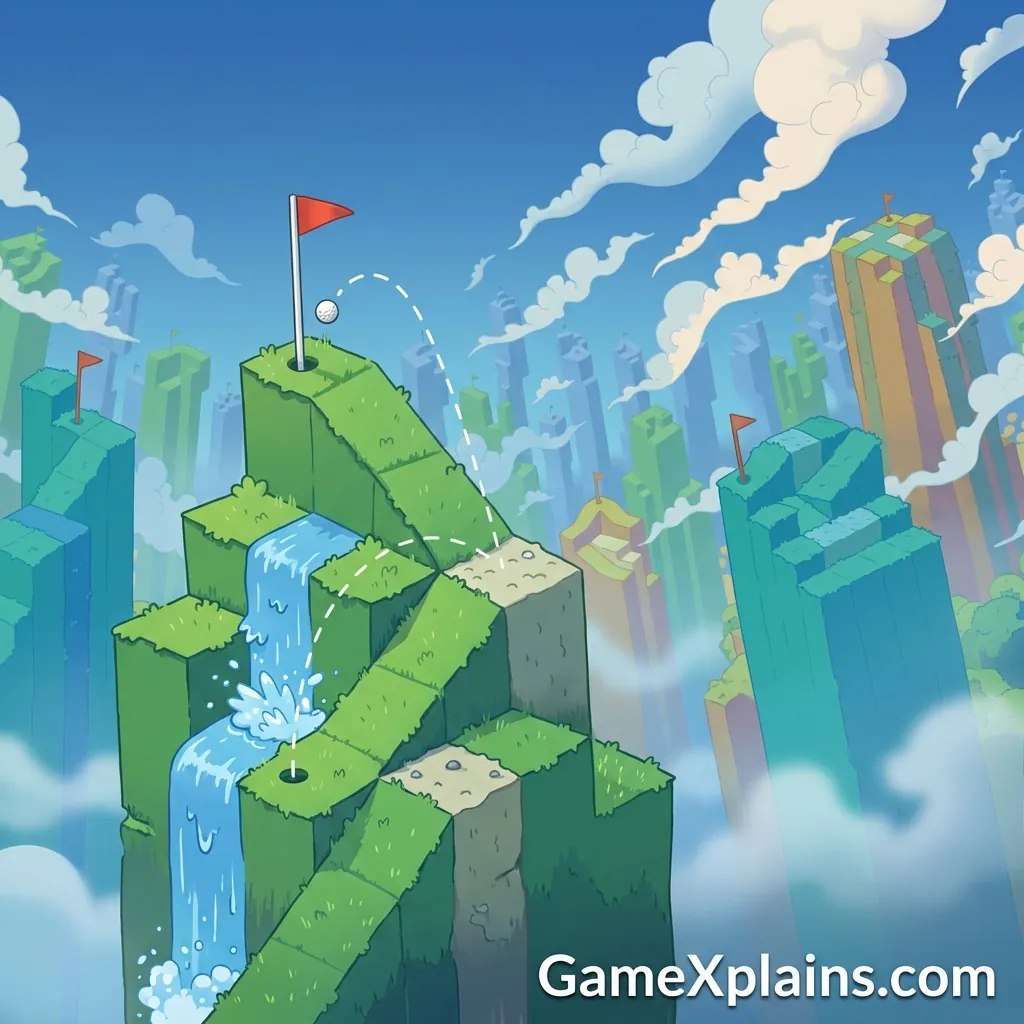
About This Game
Golf Peaks: Puzzle
1. Introduction
Golf Peaks: Puzzle looks like mini golf, but it plays like a logic grid you solve with shot cards. Each level is a compact course with a fixed number of moves, so the goal is not just to sink the ball, it is to find the clean sequence that fits the card set you are given. The satisfaction comes from spotting a line, testing it, then refining it when an obstacle or slope changes the outcome.
Play now and treat the first few holes as your tutorial for how the cards translate into movement.
Most web versions run as an HTML5 game (may use WebGL), so it should load in modern browsers with no download.
2. Key Features
Card-based shot planning that turns each hole into a compact logic puzzle.
Tight move limits that reward clean sequencing over repeated power swings.
Terrain and obstacle interactions that create readable cause-and-effect outcomes.
Short levels with quick resets, perfect for experimentation and rapid learning.
Difficulty ramp that introduces new constraints, then combines them for harder solves.
Puzzle-first pacing that favors foresight, not reflex-heavy timing.
3. What is Golf Peaks: Puzzle?
Golf Peaks: Puzzle is a puzzle-first golf game where you solve each hole by spending a small hand of cards. Cards typically represent direction and strength, and your job is to choose the right order so the ball reaches the flag within the move limit. The core loop is: scan the board, map a route, play cards, watch the ball resolve physics, then restart and adjust if the final position is off.
The tactical dynamic is about commitment and correction. Because you cannot freely aim every shot, you learn to plan around the card constraints and the board layout. What differentiates this from typical mini golf is that success is less about lining up a perfect angle and more about sequencing, counting spaces, and predicting how slopes and bumpers will redirect the ball.
If you are searching for Golf peaks puzzle online, this page focuses on how the card logic usually works in browser-style versions and how to reduce wasted moves.
4. How to Play
You clear a hole by getting the ball into the cup or reaching the flag tile, depending on the version you are playing. Each level starts with a limited set of shot cards. You play one card at a time, the ball moves accordingly, and the environment resolves the result. If you run out of cards or exceed the move limit before finishing, you fail the attempt and should reset.
Progression is level-based. Early holes teach single ideas (basic pushes, simple obstacles), then later holes stack constraints (narrow corridors, multi-step rebounds, or hazard avoidance). When people look up a Golf peaks puzzle guide, they usually get stuck when the game introduces combinations: a slope that changes distance, plus an obstacle that forces a detour, plus a move limit that punishes over-correction.
Controls (Table)
Action | Keyboard / Mouse | Touch |
|---|---|---|
Select a shot card | Click a card | Tap a card |
Confirm and play shot | Click the play/confirm area (or the course) | Tap confirm / tap course |
Restart the hole | Restart button (mouse click) | Restart button (tap) |
Undo (if available) | Undo button (mouse click) | Undo button (tap) |
Micro cue: If your shot overshoots by a small amount, restart and change the card order before changing the whole route.
Micro cue: When a rebound sends the ball wide, aim to land earlier on the bumper so the exit angle is calmer.
5. Core Gameplay Mechanics
1) Main system
When you play a shot card, the game commits you to that movement and then resolves the board physics. In most versions, the direction and distance are predetermined by the card, so your accuracy comes from choosing the correct card sequence, not free-aiming. When a card does not fit, you reset quickly and try a new order.
2) Tactical dynamics
When you see an obstacle walling off the direct line, do not immediately detour with extra moves. Instead, look for a bounce line, slope, or corridor that converts one card into two outcomes, such as a controlled rebound that both changes direction and preserves distance. When space is tight, do smaller adjustments earlier so you do not waste a strong card late.
3) Progression and scaling
When you move from early to mid-world holes, the puzzle shifts from single-interaction thinking to chain planning. You will often need to predict two resolutions ahead: where the current card leaves the ball and how that sets up the next card. Late stages typically combine hazards, narrow lanes, and stricter move counts, so cleaner routing matters more than experimentation.
4) Key elements
Key elements are your card hand, the move cap, terrain (slopes or directional tiles), and hazards that punish landing in the wrong place. If a hole includes water or out-of-bounds areas, treat them as hard fail states and route around them first, then optimize. Use restarts as part of the solve, not as a penalty.
Decision Flow (Quick Win Rule)
See the cup/flag reachable in 1 card? Yes -> Play that card -> Finish No -> Is there a safe bounce line? Yes -> Plan bounce -> Save strongest card for the exit No -> Can terrain redirect you? Yes -> Use terrain -> Recount moves No -> Restart -> Try a different card order
6. Strategies
Card Order First
Play with sequencing before you change the route. Many holes have the same path but require swapping which card happens first so you land on the right tile at the right moment. This works because early placement dictates later angles. Warning: do not burn the only strong card too early unless the finish is guaranteed.
Exit Angle Planning
Treat bumpers and corners as angle generators. Approach them so the ball exits into open space rather than into another wall. This works because the next card becomes easier when your landing position has multiple safe directions. Warning: if the bumper exit is too sharp, move the contact point back one tile.
Strong Card Conservation
Identify the cards that travel far or reposition you dramatically, then reserve one for the final approach. This works because late-stage holes often punish small errors, and a strong card can correct a longer distance without extra moves. Warning: if the layout forces an early long push, commit and optimize around it.
Two-Step Setup Thinking
Before you play a card, predict the next card you want to use and where you need to land to make it viable. This works because the puzzle is usually solved in pairs: setup shot then scoring shot. Warning: if your setup relies on a perfect bounce, choose a safer landing even if it looks slower.
Reset Without Shame
Restart quickly after a miss and change one variable at a time (card order, then bounce point, then route). This works because the level is short, and disciplined testing reveals the intended solution faster. Warning: changing everything every attempt makes it hard to learn why a plan failed.
Count Tiles, Not Hope
On grid-like holes, count how far a card moves relative to the lane length and obstacle spacing. This works because many solutions are exact, not approximate, and counting prevents “almost” landings that waste tries. Warning: if terrain alters distance, count from the redirected path, not the initial line.
If you are stuck on specific calls like Golf Peaks 5-4, Golf peaks 3 4, Golf Peaks 7 4, or Golf Peaks 7 5, the most common fix is to revisit sequencing: the correct route often stays the same, but the setup card must be played earlier so the bounce or slope lands you on the exact entry tile.
Micro cue: If a slope keeps pushing you past the safe tile, land one step before it and let the slope finish the movement.
7. Similar Games
Sudoku Brain Blocks – Number logic with structured constraints and clean difficulty ramp.
Parking Jam – Move-order puzzles where one bad pull blocks the entire plan.
Scrabble Online – Word placement and board control, slower but similarly strategic.
If you like Golf Peaks: Puzzle, you may also enjoy more Strategy games.
If you want more clean, rule-driven brain teasers, explore Logic.
8. FAQ
How long does it take to beat golf peaks?
It usually takes a few hours to finish the main set of levels, depending on how often you restart and whether you chase perfect solves. Because each hole is short, progress can be fast, but later stages slow you down with tighter move limits and combo mechanics.
What is the 15 puzzle problem?
The 15 puzzle is a sliding-tile puzzle on a 4x4 grid with one empty space, where you reorder tiles into a target pattern. The “problem” usually refers to solving it efficiently and understanding that only half of all starting positions are solvable due to permutation parity.
Which puzzle game is best for the brain?
The best puzzle game is the one you will play consistently with active thinking. Logic and spatial planning games tend to train planning, working memory, and pattern recognition. If you enjoy card-sequencing puzzles like this, mix in number puzzles or pathing puzzles to vary the mental load.
What are some fun word puzzle games?
Fun word puzzle games include classic anagram and crossword styles, tile-laying word games, and daily word challenges. If you like slow strategic turns, board-based word games reward vocabulary and planning. If you prefer quick sessions, short daily puzzles can keep the habit without long time investment.
9. Technical
Golf Peaks: Puzzle is commonly presented as an HTML5 game for web play (it may use WebGL for rendering). You can typically play this online/browser game in Chrome, Firefox, Safari, or Edge. Most mid-range laptops and phones should run it smoothly as long as the browser is up to date.
Controls are simple: you select a card, confirm the shot, and use restart or undo when available. For players searching Golf peaks android, mobile versions usually emphasize touch-first input with the same core card logic. If your browser version offers instant loading, it is effectively no download.
Note: features like undo limits, level packs, or cosmetic items can vary by platform and build.
10. Final Verdict
Golf Peaks: Puzzle is a smart, compact online/browser game that turns golf into pure sequencing. Its strengths are clarity, fast restarts, and satisfying “one-card fixes” when you finally see the intended route. Its limits are that some solutions can feel exacting, and small physics differences between versions may change how forgiving a bounce feels.
If you enjoy route planning, move efficiency, and clean logic, this is a strong pick, especially when you want a free puzzle game experience with no download in a browser. It is also a good fit if you like chasing specific solutions such as Golf Peak Hat style cosmetic goals, when those appear in your version.
Comments (0)
No comments yet. Be the first to share your thoughts!