Sudoku brain blocks
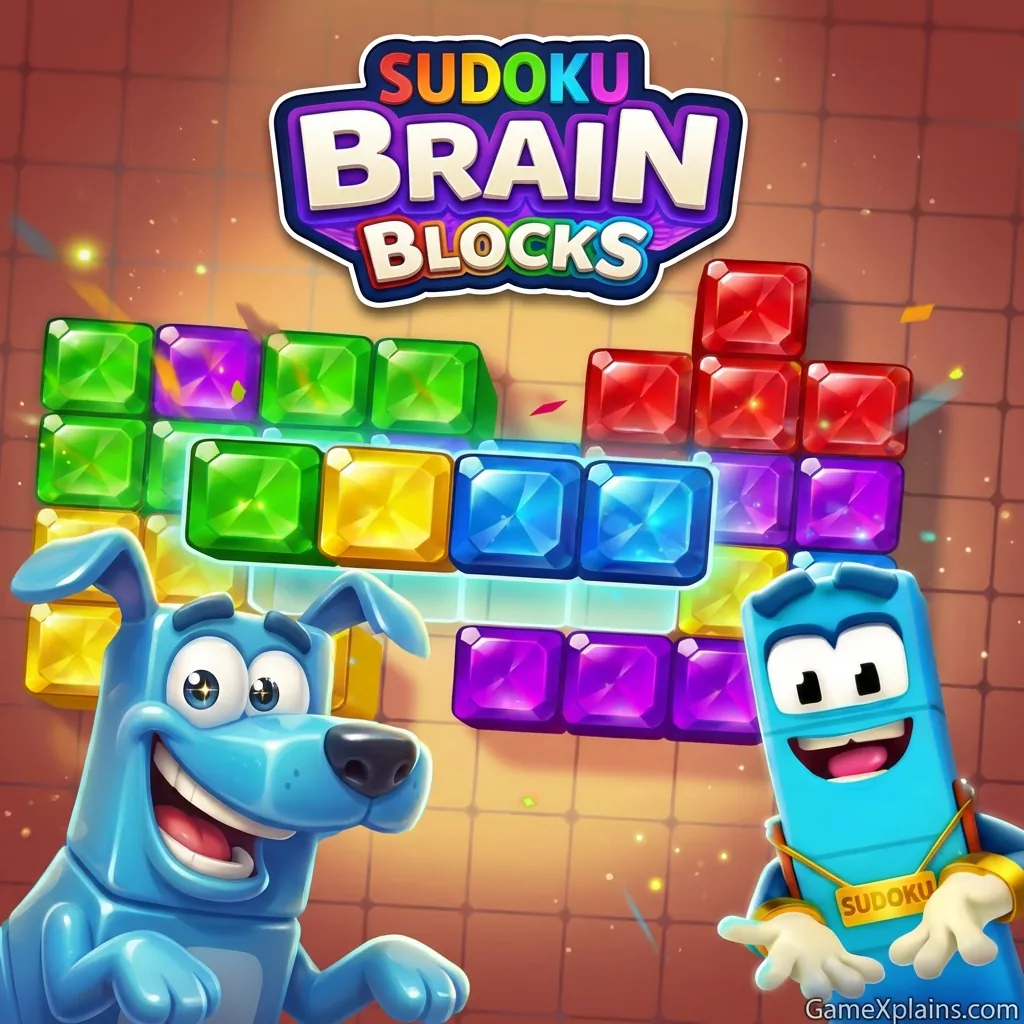
About This Game
Sudoku Brain Blocks
1. Introduction
Sudoku Brain Blocks blends classic Sudoku logic with block placement pressure, so you are not only solving digits, you are managing space. The loop is simple: place number blocks, keep rows and columns valid, and avoid boxing yourself into impossible gaps. This guide explains the rules, common fail states, and the habits that make the game feel consistent instead of random.
Play Now: Start Sudoku Brain Blocks and practice one clean game focusing on mistakes, not speed.
This is typically an online/browser game built as an HTML5 game (it may use WebGL), so you can usually play with no download on modern browsers.
2. Key Features
Sudoku logic with block placement, forcing you to plan space two moves ahead.
Short sessions with quick resets, good for daily practice and pattern spotting.
Clear fail state when the board cannot accept any remaining blocks.
Mix of digit constraints and layout constraints for a different Sudoku game rhythm.
Helpful visual feedback for conflicts, so mistakes are obvious and fixable.
Works well as a daily routine, similar to Daily sudoku brain blocks habits.
3. What is Sudoku Brain Blocks?
Sudoku Brain Blocks is a Sudoku game that typically uses a 9x9 Sudoku-style grid, but instead of filling single cells one by one, you place grouped “Sudoku blocks” that carry numbers. Your role is part solver, part planner: maintain valid Sudoku lines (no repeats in a row, column, and usually each 3x3 box) while also fitting awkward shapes efficiently.
The core loop is: read the next available blocks, test safe placements, commit, and then look for clears or new openings created by your move. The tactical dynamic comes from the queue of pieces. Even with perfect Sudoku knowledge, bad spacing can end your run, which is why Sudoku Brain Blocks online often rewards patience over speed.
4. How to Play
In most versions, you drag or click a numbered block and place it onto the grid. A placement is valid only if every number in that block lands in a legal cell. If you create a duplicate in a row, column, or 3x3 region, the game usually rejects the move or flags it as invalid.
Win/Lose: Many versions are score based rather than “you win the puzzle.” You keep playing until you cannot place any of the remaining blocks, then your run ends. You improve by learning how to avoid dead zones and by recognizing when a risky placement is actually the only path forward.
Progression: Difficulty often ramps through more awkward shapes, tighter spaces, or less forgiving queues. Some builds also add daily challenges (the Daily sudoku brain blocks idea) where you aim for a higher score using the same seed.
Controls (table)
Action | Mouse / Keyboard | Touch |
|---|---|---|
Pick up a block | Click and hold | Tap and hold |
Place a block | Drag to a highlighted area, release | Drag to a highlighted area, release |
Cancel placement | Drag off-grid, release | Drag off-grid, release |
Restart run | On-screen restart button (varies) | On-screen restart button (varies) |
Practical cue: If you keep “almost fitting” L-shapes but they fail, you are probably creating 1-cell gaps that no shape can cover later.
5. Core Gameplay Mechanics
1) Main system (space plus rules): When you place a numbered block, the game checks every digit in that piece against the current grid. If any digit breaks Sudoku constraints (duplicates in a row, column, and typically the 3x3 box), the placement is rejected or marked as a mistake, depending on the version. Legal placement also requires physical space for the shape.
2) Tactical dynamics (reading the queue): When you see three upcoming pieces that share a footprint style (for example, long bars or chunky 2x2s), treat your open areas like parking spots. Make the spot first, then fill it. If you reactively jam pieces into any open patch, you usually create trapped cells that force a loss even when the numbers look clean.
3) Progression and scaling (pressure builds): As your grid fills, each placement reduces flexibility and increases the cost of a mistake. Early game is about building wide, clean lanes. Mid game is about preserving at least one flexible “work zone” where multiple shapes can fit. Late game is about survival: prioritize placements that keep options open over placements that chase a small score bump.
4) Key elements (resources and fail states): Your main resource is empty, usable space. Hazards include 1-cell holes, thin corridors, and boxed-in 3x3 regions with awkward missing numbers. The usual fail state is having no legal placements for the current set of blocks. Some versions also penalize invalid attempts, so limit trial-and-error.
6. Strategies
Corner Budgeting Reserve one corner as a “shape buffer” and keep it relatively flat. This gives you a consistent place to park long or odd pieces without twisting your whole board. It works because space mistakes compound over time. Warning: do not overprotect the corner if it blocks a critical 3x3 region.
Box-First Scanning Before placing, scan the most crowded 3x3 box and ask which numbers are already repeated across its rows and columns. Place pieces that satisfy that box’s constraints first. This works because tight boxes create the earliest hard locks. Warning: if the piece shape cannot fit cleanly, solve space first.
Three-Piece Planning Treat the set of available blocks as a mini puzzle. Place the first piece only if you can still place the other two afterward. This is the most reliable way to avoid surprise losses in Sudoku Brain Blocks free runs. Warning: if two pieces are both large, accept that one might be “sacrificial” and plan accordingly.
Gap Detox Rule Any time you create a 1x1 or 1x2 gap, immediately plan how it will be filled. If there is no realistic filler, undo by choosing a different placement. This works because tiny gaps are the most common hidden loss condition. Warning: some versions have single-cell pieces, so confirm your piece set.
Row and Column Anchors Pick two rows and two columns you want to keep flexible and avoid overfilling them early. Keep them as your routing lanes. It works because anchor lines give you multiple future fit options across the board. Warning: do not ignore the 3x3 boxes, anchors still must obey box logic.
Solver Mindset, Not Guessing Use a Sudoku solver habit: eliminate, then commit. If a digit in a piece would duplicate immediately, stop. If it fits only in one location without breaking rules, place it and move on. This works because consistency beats speed. Warning: do not tunnel on digits and forget shape fit.
Decision Flow (Quick Win Rule) Do you have a legal spot for all 3 pieces? Yes -> Place the most restrictive piece first No -> Can you create space without breaking Sudoku rules? Yes -> Build a clean lane -> Recheck all 3 pieces No -> Place the piece that preserves the largest open area Then -> Avoid 1-cell gaps -> Continue
Practical cue: If you are tempted to use a Sudoku solver tool mid-run, pause and instead mark the single row or box that is actually causing the block.
7. Similar Games
Golf Peaks: Puzzle – Compact logic puzzles with planning and clean move efficiency.
Parking Jam – Space management puzzles with sequencing and bottleneck clearing.
Scrabble Online – Word placement strategy with board control and scoring tradeoffs.
If you want more thinking-heavy sessions beyond this free puzzle game, explore Strategy.
If you prefer stricter deduction and rule checking, explore Logic.
8. FAQ
How does Sudoku affect the brain? Sudoku exercises attention, working memory, and pattern recognition. You practice holding constraints in mind while eliminating options, which can feel like mental “reps.” It is not a guaranteed way to prevent cognitive decline, but it can support problem-solving habits and focus when done regularly and calmly.
What is the 159 rule in Sudoku? The “159 rule” is not a universal Sudoku rule, and many players never use it. In some communities it refers to a specific pattern or shortcut used in certain variants. For standard Sudoku, rely on consistent techniques like scanning, candidate elimination, and box-line interactions rather than a single numbered rule.
Is Sudoku for high IQ? No, Sudoku is not only for high IQ. It rewards practice, patience, and learning a few reliable techniques. Many strong solvers are simply consistent and methodical. If you enjoy the process, you will improve over time, especially in an online/browser game format where quick restarts make practice easy.
Do people with ADHD like Sudoku? Many do, but it varies by person. Sudoku can be satisfying because it has clear rules, quick feedback, and small goals. Others find it frustrating if they dislike sustained attention tasks. If you have ADHD, short sessions and lower difficulty can help you stay engaged without burnout.
Practical cue: If you lose focus, switch to a “one box at a time” goal instead of trying to manage the whole grid.
9. Technical
Sudoku Brain Blocks is usually delivered as an HTML5 game (may use WebGL), meaning it should run in Chrome, Firefox, Safari, and Edge as an online/browser game with no download. Most mid-range devices should handle it smoothly because the visuals are grid-based, but performance can vary if the page runs heavy ads or background animations.
Controls: Typically mouse drag-and-drop on desktop, touch drag on mobile. Some versions include undo or hints, but not all. If you are looking for Sudoku brain blocks printable play, you might instead search for a Sudoku brain blocks pdf or Sudoku brain blocks printable worksheets, which are separate from the interactive version.
10. Final Verdict
Sudoku Brain Blocks is a smart twist on Sudoku because it forces you to respect both number legality and physical space. As a free puzzle game, it is best for players who like steady improvement: you can test habits, learn queue planning, and build a calmer Sudoku solver mindset. The main limitation is that later boards can feel punishing if you allow small gaps early.
If you want a Sudoku blocks experience that fits quick sessions, open it as an online/browser game, play one run, and focus on keeping a flexible work zone. Since it is typically an HTML5 game with no download, it is easy to return for Daily sudoku brain blocks style practice.
Comments (0)
No comments yet. Be the first to share your thoughts!